
You may have heard that holstering a gun in your waistband (also known as appendix carry, or AIWB) can be a bad idea. You may have been told that carrying OWB or holstering your gun in a strong-side position on your hip is the best way to enjoy fast and accurate access to your sidearm without compromising on safety.
The reality, however, is that the advantages of appendix carry are hard to deny, and its safety is actually comparable to strong-side carry. The key to appendix carry safety is the same as the key to safely handling your firearm at any time--responsible gun ownership.
What are the advantages of appendix carry?
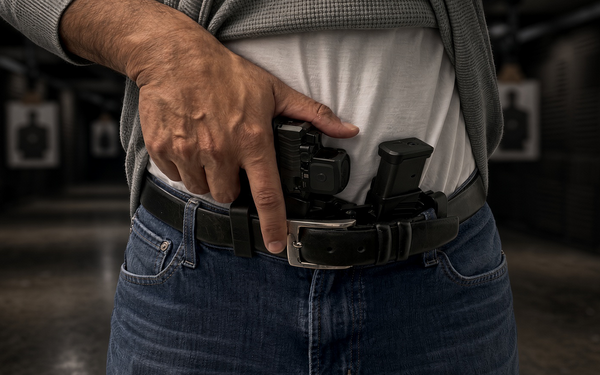
Carrying a gun in an AIWB position gives you fast access to your handgun by placing it where your hand naturally rests. From almost any position (sitting, standing, bending over), you can easily utilize your handgun. For surprise or close-quarter encounters, this positioning provides a definite advantage over other forms of carry.
Add in the fact that the body is usually shaped so as to make it simple to conceal your handgun at the front under a loose shirt, and it is obvious why appendix carry has been the carry style of choice for many years (Even long before IWB holsters became popular).
What are the risks of appendix carry?
The biggest risk of appendix carry is the impact that a negligent discharge could have on the gun owner. Negligent discharges can happen in any carry position, but when they occur from appendix carry, they could impact a critical area of the body that includes the groin and the femoral artery. A negligent discharge from this position could easily be life threatening.
A secondary, but related, concern is where the gun points when holstered on in the waistband: Toward the groin area. This positioning would seem to violate one of the central rules of gun handling: Never point a gun at something you do not want to destroy.
For individuals who want to use appendix carry, the risk of injury during negligent discharge and the direction the gun points are often deterring factors. But, should it be? There are some reasons to think that appendix carry is really not that dangerous, particularly for responsible gun owners who take the time to mitigate the risk.
All gun handling carries risk.
You cannot eliminate risk, no matter how you carry your gun. Fatigue, hunger, your mood, your circumstances, and a thousand other details can impact how safe your gun handling is in any one moment.
You can just as easily have an accident with a strong-side carry, with an OWB carry, while practicing on the range, or in any other scenario.
With that in mind, the most important mitigating factor is not how you carry your gun. It is practicing responsible gun ownership.
In particular, it is important to (1 Choose your gun and holster wisely (2 Familiarize yourself with your gun, (3 Practice regularly with your gun and holster, (4 Implement reasonable safety practices and (5 Refrain from practicing with or using your gun when you are not clear headed.
All of these habits of good gun ownership are possible no matter how you carry your gun.
Risk mitigation is possible.
Let's look specifically at the two arguments against appendix carry: That the muzzle of the gun points toward the groin area, and that negligent discharges can have serious consequences.

Comments (3)
I appendix carry and highly recommend it. #stillnotshootingblanks
Terrible advice! You even depict all of the vital areas the gun WILL be pointed at in AIWB. Doesn’t even make a bit of sense. I do not care what kind of holster you have, what kind of gun, or how much training. You are asking for a REALLY bad injury if an ND is to occur. I’ll take a graze down my leg or in the keister before a direct hit to the lap area. Gotta be kidding me…
Revolvers are safer and you can still get immediate firing action, even if you keep the cylinder empty so that you don’t have a bullet staring down the barrel. You can even reduce risk of shooting yourself during a hurried, excited draw by leaving the next in rotation cylinder empty. Revolvers rule!