

I press-check my carry gun. A lot. Some people would call it religious. They’re not wrong.
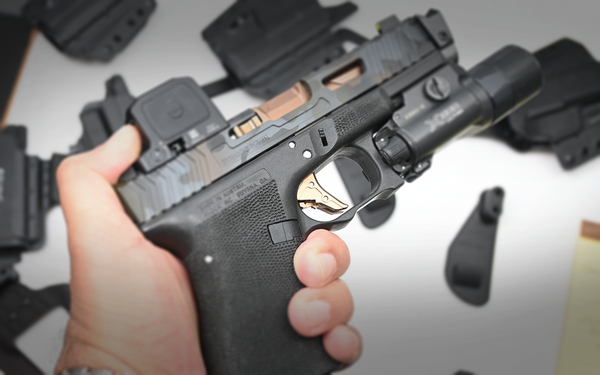
A press check is not a full rack. I pinch the rear of the slide—or use the front serrations if that’s what the pistol gives me—and pull it back just far enough to see brass in the chamber. Then I let it return to battery and maybe give it a light tap behind the slide just to make sure. Muzzle in a safe direction. Finger off the trigger the entire time. I’m not ejecting anything. I’m just looking.
I do it because I want to know, not assume.
When I pick the pistol up in the morning, after it’s spent the night in the safe or on the nightstand, I want visual confirmation that a round is sitting where it should be. Same thing after a range session when I reloaded and holstered. Same thing if anyone else has handled the gun. Modern semi-autos are extremely reliable. The slide almost always strips a round off the magazine and goes into battery. Almost. I’ve seen enough failures to feed, dirty chambers, and “I was sure I loaded it” moments to prefer seeing it myself.

The habit also keeps me honest. Every time I crack that slide, I’m forced to treat the gun like a loaded firearm—because I’m verifying that it is one. That extra second of attention is cheap. In a defensive pistol, the first shot is the one that matters most. I want the highest possible chance that it actually happens.
That’s the “why it’s good” side. It’s verification. It’s consistency. It’s refusing to outsource certainty to memory or to a loaded-chamber indicator that can get dirty, stick, or sit in a position I can’t easily see in low light.
Now the other side: why it often doesn’t matter.
If I just loaded the gun myself—inserted a full magazine, racked the slide, felt and heard it go into battery, and immediately holstered it—the chance that it failed to chamber is tiny. If the pistol never left my control, nobody else touched it, and I didn’t drop it, I’m already operating at a very high confidence level. Doing another press check at that point is more ritual than necessity.
Some instructors go further. They point out that every extra manipulation of a loaded gun is an opportunity for a mistake. Negligent discharges happen during administrative handling more often than during actual fights. If you already know the status because you just created it, extra handling adds risk for almost no gain. They’re not entirely wrong.

Loaded chamber indicators and chamber windows change the math too. On guns that have a reliable visual or tactile cue, you can often skip the slide movement altogether. Repeatedly cracking the slide, even a little, also isn’t free. Recoil springs and extractors last a long time, but they don’t last forever. Doing it twenty times a day out of habit just accumulates cycles.
So I land in the middle, and that’s been my practice for years.
I religiously press-check when there is any real doubt: first thing in the morning when I put the gun on, after storage, after someone else has handled it, after I’ve unloaded and reloaded at the range. I do not do it every time I glance at the holster during the day. I don’t do it for show. I don’t treat it like a superstition that must be performed or the gun will fail. I treat it like a tool. When the status isn’t freshly verified by me, I verify it. When it is, I leave it alone.
That’s the whole thing. The gun is either ready or it isn’t. I’d rather spend two seconds finding out than discover it the hard way. Press checks are free when you need them and unnecessary when you don’t. Use them accordingly.
Comments (4)
I’m definitely not an expert. Reading these adds knowledge bit by bit. It helps me change from I want to can I use properly and effectively.
Hey Renee. I don’t know when it started. I’ve had my concealed carry license for a little over 5 years now. I think I unknowingly started doing this after about a year and a half of having my license. After that first year and a half, I felt comfortable carrying with ‘one’ in the chamber. Not as often, but I still visually check when I need to. Pointed in a safe direction, finger off the trigger, and usually when no one’s around.
I press check my EDC gun every time before I put in on my belt. I also press check if I do a tactical reload, But when in a gun do not have time to do press check. If there is a malfunction in a gun muscle memory does a slap rack ready ! If malfunction still present rip magazine reload a fresh magazine.
Good information, keep it coming. Thanks